

The single issue we should all care about
Tragically, media outlets are less interested than ever

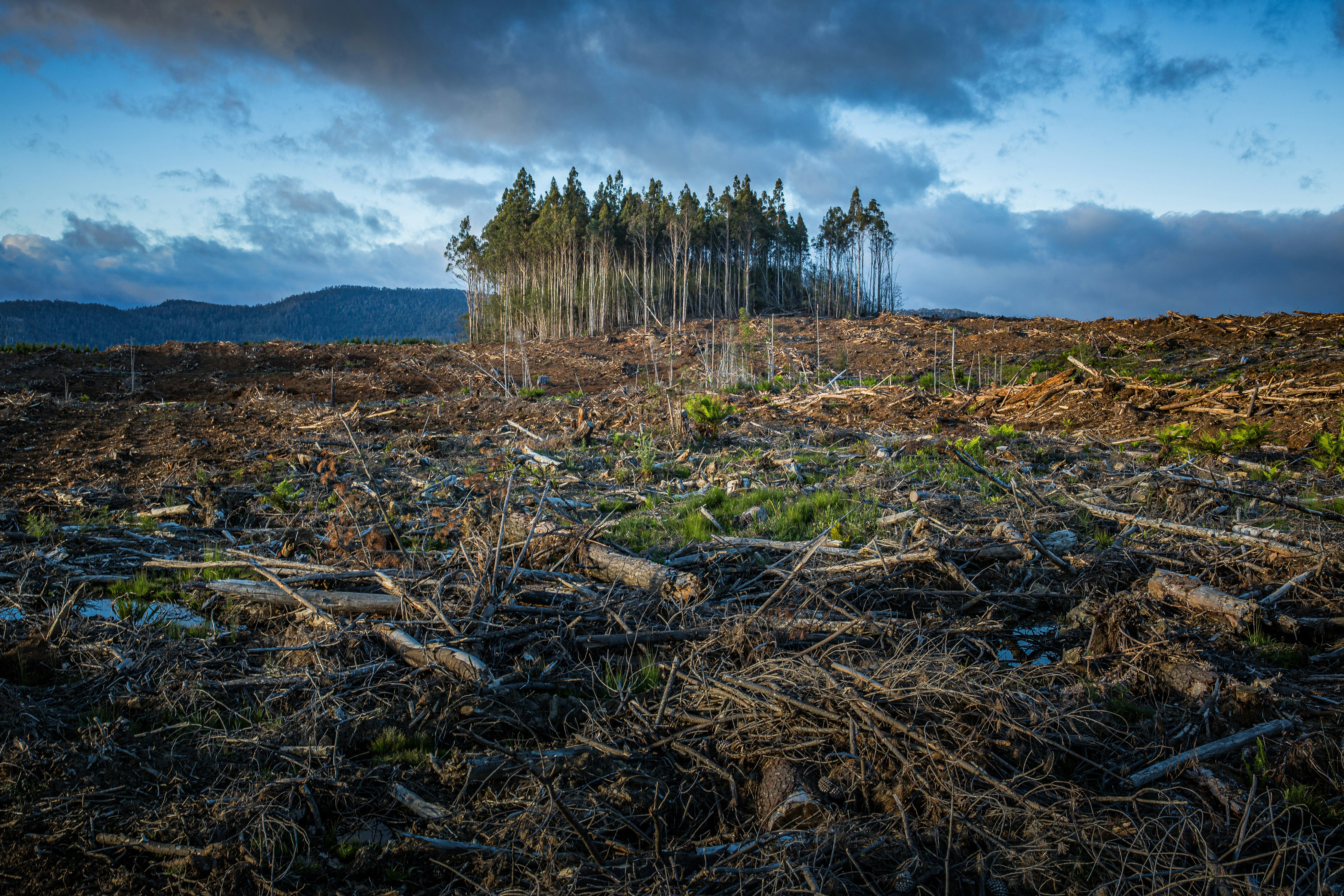
Wildfire smoke is rolling into Portland as I write. Not too bad today—unhealthy for sensitive groups. Over the next two days, however, it’s going to get bad. In fact, Oregon has already experienced the worst wildfire year on record (for most acres burned), and it’s the first week of August.
The previous record was set in 2024.
What a time to be writing about climate reporting, but here we are.
Last week, Wall St Journal science reporter Aylin Woodward announced she was leaving the publication with this post:
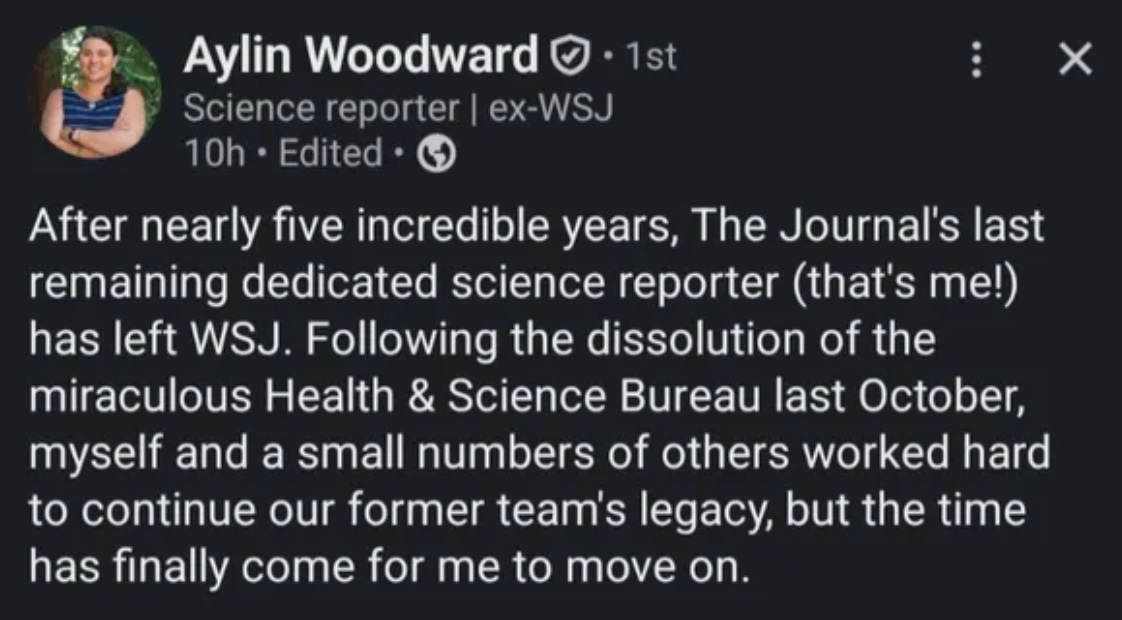
I’m not sure if she quit or was forced out, but her story is part of a much larger issue going on with science reporting in American media—specifically, climate reporting:
NPR disbanded its standalone climate desk in May 2026 amid federal funding cuts. Two staffers were laid off while eight other reporters were folded into the National Desk. A total of 10 journalists were cut.
CBS News gutted its six-person climate team in October 2025 shortly after Bari Weiss was installed as editor-in-chief. Then correspondent David Schechter was laid off himself in March 2026, leaving CBS with zero climate reporters. One producer, Tracy Wholf, went on to join the independent outlet “Heated,” which sadly is what many of these journalists are forced to do given how few positions remain.
Washington Post laid off at least 14 climate journalists during its February 2026 bloodbath, in which over 300 newsroom jobs were terminated by one of the world’s richest men.
Los Angeles Times columnist Sammy Roth, one of the paper’s most prominent climate writers, departed after seven years at the paper. A year later the newsroom cut 115 jobs, including a number of climate reporters. And, you know, why would LA have to worry about climate change?
This is part of an industry-wide reporting problem:
Grist found a 38% drop in global climate coverage since peaking in 2021
Media Matters found a 35% decline in climate airtime on CBS, ABC, and NBC between 2024-25
Roughly 10,000 journalists have been laid off in the past three years
While this is a media problem, it’s not separate from an administration problem. We know how much Trump loves talking to reporters and hates them reporting on him. Project 2025 specifically calls for the defunding of NPR and PBS and the disbanding of outlets like the Voice of America. Trump’s cronies have done everything possible to make these happen. When it comes to broader climate reporting, they’ve been successful in stopping journalists through agency cuts.
The big one is the National Oceanic and Atmospheric Administration (or NOAA), which has fired roughly 2,000 employees (20% of its workforce) since January 2025. It was one of the first agencies DOGE went after. These cuts affected regional media heavily: 30 of the National Weather Service’s 122 forecasting offices, including ones covering New York, Houston, and Cleveland, lacked chief meteorologists. Some offices stopped providing 24/7 coverage. One instance of collateral damage: Louisville’s office couldn’t confirm tornado touchdowns for days due to short staffing.
Also affected via NOAA: twice-daily weather balloon launches, which provide core data for forecast models, were suspended or scaled back at multiple sites. The agency also halted maintenance on polar satellites that track atmospheric systems globally.
NOAA discontinued its billion-dollar disasters database in May 2025, which was a widely-cited dataset tracking the cost of major weather and climate disasters. The agency ended its 15-year run of monthly climate media briefings in March 2025. The reason? Axios reports it was out of “fear of angering the administration by discussing human-caused global warming.”
The Environmental Protection Agency isn’t doing much protecting lately either. In December 2025, the agency removed at least 80 climate-related webpages, deleted its Climate Change Indicators and Climate Change Impacts and Analysis sections, and rewrote remaining pages to downplay human causes of warming. One analysis found that there have been over 500 similar changes to federal climate web content since Trump retook office.
It’s an assault on multiple fronts: first, stop providing tools climate reporters need to do their job. Second, cut so many jobs that those agencies themselves are unreliable, which lessens public trust in their reporting. For example, forecast error margins have widened to 5-10 degrees over the normal 2-3 degrees, which will make citizens tune out more often.
Not that we haven’t been tuning out already. This is where the media requires a relationship with citizens. And I know from experience how challenging it is to write about climate change. For nearly a decade, I was a health and science columnist for Big Think, during which time I wrote over 1,000 articles. A few titles include:
Are we prepared for climate change? Health experts say no (7/25/18)
Climate change is here. It’s time to begin “managed retreats” according to scholars. (8/27/19)
How we view our environment impacts our wellbeing, says Australian philosopher (9/23/19)
Jon Snow and Daenerys Targaryen’s Face-to-Face Shows the Myopia of Climate Change Denial (7/31/17)
At some point, my editor reached out, telling me to stop writing about climate change. Some of my top performing articles could get over a million views. On average, they were in the tens of thousands. Like it or not, their model largely relied on clicks, which I know is its own problem. But my editor said the worst-performing articles, by me and other writers, were about climate change. Big Think is a site dedicated to big ideas in philosophy, politics, science, literature, but the audience just didn’t care to read about climate change.
This is not an isolated incident. I’ve interviewed authors who wrote about the topic as well as climate reporters. It’s always been an issue, even when we try to use pop culture references (like Game of Thrones) to drive attention. This doesn’t mean that all climate writing is ignored; there are fantastic reporters out there covering how we’re negatively impacting our planet. But the day to day coverage has long been background noise to so many, maybe because the problem seems so large that we’ll never get a handle on it, or maybe because, as often happens in life, until something affects us personally, the topic is placed in a down the road bucket to worry about later, if at all.
That’s in no way to excuse the Trump administration’s assault on climate change reporting or mainstream media gutting science departments. I believe we need this reporting now more than ever. But industry wide, we’re sliding backwards, both in terms of our grip on the climate and our ability to talk about it. I have to turn to places like Nature Communications, Carbon Brief, and Science Daily, which are more aggregators than narrative storytelling, to discover recent stories like the following:
Public Health France doubled its preliminary estimate of the “excess deaths” from the extreme heat in late June, from 1,000 to more than 2,000, then raised it again to 5,700
The UN World Meteorological Organization raised its forecast for the rapid emergence of a strong El Niño in the coming months, warning that the phenomenon is likely to drive global temperatures higher
Oxygen is disappearing from oceans, lakes, rivers, and coastal waters at an alarming rate, threatening aquatic life and weakening the natural processes that help regulate Earth’s climate. Scientists warn that this widespread deoxygenation is closely connected to other major planetary threats, including warming, pollution, biodiversity loss, and ocean acidification.
The world’s longest-running soil warming experiment has revealed an unexpected climate concern. After nearly four decades, researchers found that warming can cause microbes to break down stable soil carbon that scientists once believed was largely protected. That releases extra carbon dioxide into the atmosphere, potentially accelerating global warming.
Each of these stories should be covered broadly by every outlet imaginable. And certainly, some outlets do. But I had to turn to science-specific aggregators to find them, where they’re buried among dozens if not hundreds of stories churning through the feed on a daily basis.
Tragically, we’re likely not going to be aware of any of this until it’s at our front door.
Like today, in Portland, and across the Pacific Northwest.