

Liner Notes: Mos Def gets ecstatic
This 2009 classic is finally getting its day

Originally written for Sonic Grid. Sign up today as the platform launches soon, and we’ll be featuring a lot more in-depth liner notes, new music features, and much more.
Some albums hit later on.
John Coltrane’s big band instrumentation threw everyone for a loop in ‘61. Fans were craving another Giant Steps or My Favorite Things. Instead they got the mythological tour de force known as Africa/Brass.
Downbeat panned it. Most ignored it.
Now it’s considered a masterpiece.
Seventeen years later, Marvin Gaye recorded a bitter concept album with half the royalties going to his recently divorced ex, Anna. He wanted “nothing even good” on it. Then he walked into the studio. The double-LP Here, My Dear was panned upon release. The public only started tuning in after his death six years later.
Rolling Stone included it in the 500 Best Albums of All-Time list in 2020.
I’d put Common’s epic 2002 experiment, Electric Circus, in this camp, though it’s still generally ignored. Perhaps its day will come.
An album no longer being ignored is Mos Def’s 2009 cruiser, The Ecstatic.
The man now known as Yasiin Bey had quite a run: Black Star alongside Talib Kweli in ‘98; Black on Both Sides, one of hip-hop’s essential albums, the following year; The New Danger in ‘04, where Mos introduced the Black Jack Johnson project, ensuring rap didn’t lose its rock roots. True Magic had a few bangers in ‘06, but the man’s power was waning. Personal problems combined with a renewed focus on acting split his energy.
The Ecstatic is Def’s last solo album (save 2019’s Negus, only performed at art galleries, so: different category). It did a’ight: 168,000 copies sold, peaked at #9 on Billboard. More critic’s charm than music lover’s haven. Then it mostly disappeared, never landing on streaming, which, in terms of our cultural short attention span, equals death.
That’s changing. The Ecstatic is being reissued on vinyl in August, with streaming rights exclusive to Qobuz. (A recurring trend: the second Black Star album, 2022’s No Fear of Time, is only available online via the podcast network, Luminary.)
Regardless, people are talking about the album again, remembering, psyched, reminiscing about a moment in time that slipped through the cracks.
Digging through my hard drive filled with the mp3s of burned CDs, I can confirm The Ecstatic is one of those albums, 17 years later, worthy of as broad an audience as possible.
It still hits. Now, many new fans will discover a classic.

Few lyricists turn syllables into weapons like this man. Catching Mos live five times over a 20-year stretch, I’ve always been lulled by his furious calm. The Ecstatic is the type of album an honor’s seminar can be devoted to. So much to unpack yet so approachable.
The producer list is legendary. Oh No opens the album with “Supermagic,” sampling his own track “Heavy,” which pulls heavily from Turkish psychedelic-folk singer Selda Bagcan’s brilliant 1976 cut, “Ince Ince Bir Kar Yagar.” Dr Dre would later snag a sample for his Compton record.
Madlib. Preservation. Mr Flash. The Neptunes revive a moment from their 2003 Outkast joint, “Ghettomusick,” setting the tone of “Twilite Speedball.” Brilliant self-referential sampling, like a seventies-era Bronx DJ looping the break of old funk on two decks.
George Anne Muldrow also croons over her jazzy beat. Talib Kweli reunites on a Dilla joint.
Then there’s Slick Rick, la di da diing over Madlib’s beast. The strings ring familiar to Bollywood fans, who’ll pick out “Do jhooth jeye ek sach ke liye” by the legendary Lata Mangeshkar. A deeper sample arrives via Minoo Purshottam. The entire album is, in fact, a goldmine for crate diggers.
Mos has never shied from politics. He’s advocated for Palestinian independence for decades. Hop over that eastern border to find the theme woven throughout The Ecstatic: essentially, an anti-Iraq War album.
The sonically rich tapestry points to Def’s Muslim faith: a call to prayer, Arab strings everywhere, and on “Auditorium,” Slick Rick’s unforgettable rhyme, worth ingesting in full:
Sit and come relax, riddle of the mack
It’s the patch, I’m a soldier in the middle of Iraq
Well, say, about noon-ish, comin’ out the whip
And lookin’ at me curious, a young Iraqi kid
Carryin’ laundry, “What’s wrong, G? Hungry?”
“No, gimme my oil or get fuck out my country”
And in Arabian barkin’ other stuff (“Jihad!”)
‘Til his moms come grab him and they walk off in a rush
Distrust, feelin’ like I’ve pissed upon wound
I’m like, “Surely hope that we can fix our differences soon!” (Bye!)
Buyin’ apples, I’m breakin’ on, “You take everythin’
Why not just take the damn food, black bastard?”
I don’t understand it, on another planet?
15 months of this stuff, how I’m gonna manage?
And increasin’ the sentiment
Gentlemen gettin’ down on their Middle Eastern instruments
Realized trapped in this crap
Walk over, kicked one of my fabulous raps (“La-Di-Da-Di”)
Arab jaw drop, they well wish, they glad rap
Now the kid considered like an Elvis of Baghdad
“The Embassy” is the record’s most Middle East-coded beat. Mr Flash samples Ihsan Al-Munzer’s banger, “The Joy of Lina (Farha),” pulled from an album with a cover disturbingly reminiscent of how they did Miles wrong on Miles Ahead (something Davis never forgave the label for):
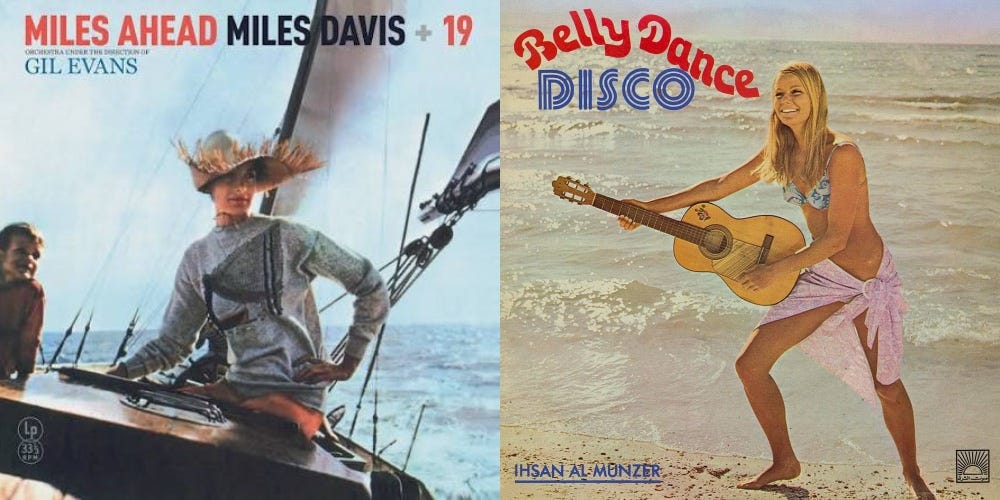
But you gotta sell records to white people, or so label thinking went. Jump to Mad Men S3: Pete Campbell realizes Black people (“negroes” in his parlance) are Admiral’s most fervent television buyers. The executives balk when he recommends the C-Suite buy cheap ads in Ebony and Jet. We want Black people to buy them because they think white people want them! is their jaw-dropping but perfectly tone-deaf response.
The covers above: same energy. Mos would have none of it. He’d earn his art by this point. The Ecstatic’s cover is pulled from Charles Burnett’s 1978 film, Killer of Sheep, which investigates the grueling working class life of 1970’s Watts.
Al-Munzer’s joint is obscure, but Mr Flash digs even deeper when lifting the rolling bass line that opens “The Embassy” from Roger Gravel’s psychedelic romper, “NucléOn.”
Then there’s Fela. There’s always Fela. “Quiet Dog Bite Hard” is The Ecstatic’s most exuberant track, punchy like “Sex, Love & Money,” simple bass and percussion driving a rhythm while Def punches each beat with imaginative portraiture:
There it go like simple the plainness, it’s primal and basic
Zulu arrangement, rockin’ amazement
Flaco, radiate from Heaven to pavement
They phony as a facelift, I’m nothing to play with
Spent time hating it, but that ain’t changing it
God give it to me, nobody is takin’ it
Therefore, moving on the base for stimulus
I’m standing in the twilight and watching them get it in
The walls are tremblin’, the air is simmering
She movin’ like more than her ears are listenin’ – whoa now
Testin’ your equilibrium
Sonic wave booming all over your intimate
Skin on skin, and skin on skin again
Put it all, get it all, get on, get it in
Shortly after The Ecstatic dropped, Mos retreated. Done with the industry. Done with chasing clout. Done with his name: Yasiin Bey emerged shortly after. This gem of an album got tangled in a lot of non-music stories, his family trouble, his time in South Africa, his protest reenactment of a detention camp in Guantanamo Bay.
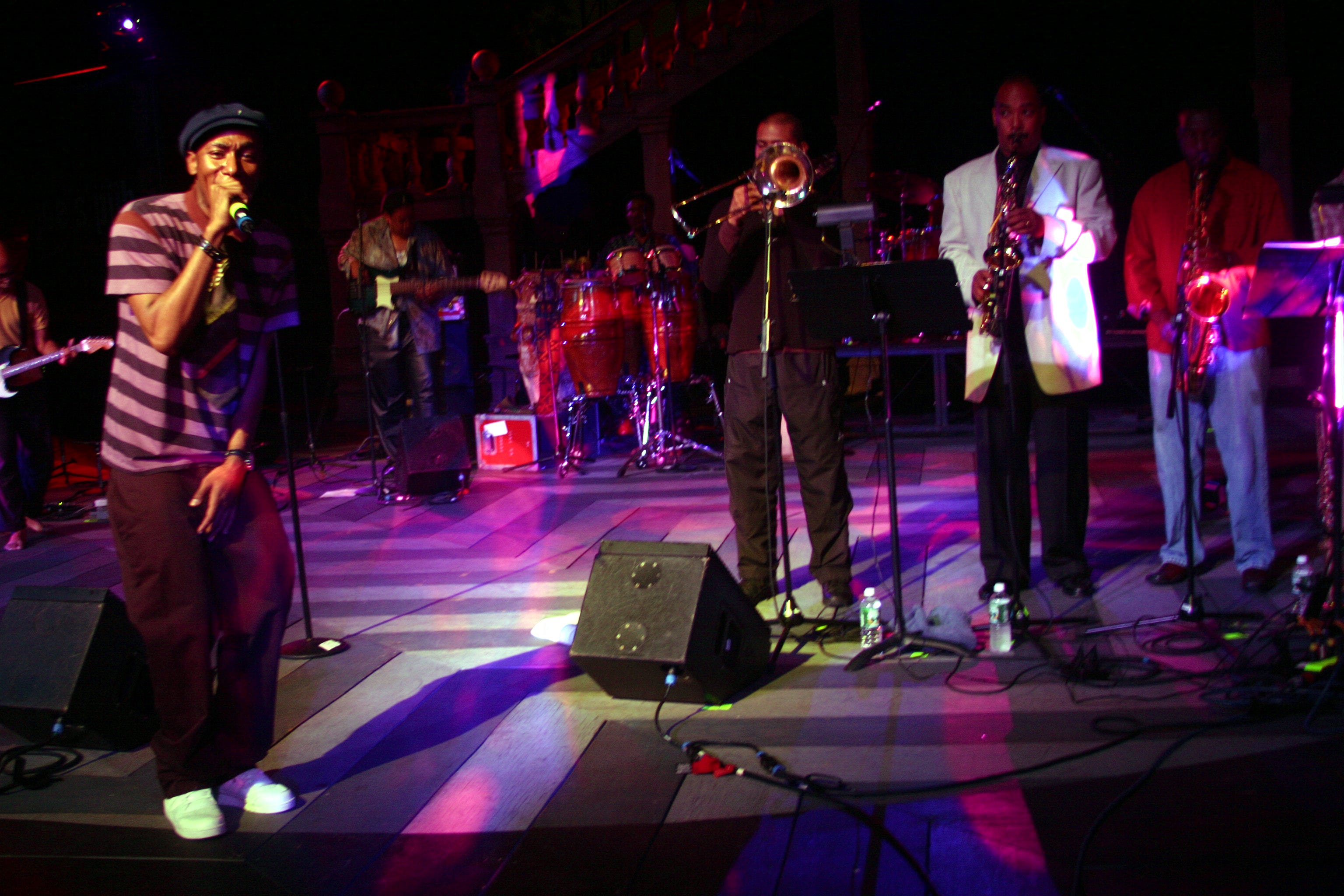
Mos—Yasiin—has always been larger than his time. I can’t shake that “Respiration” lyric in ‘98 from Black Star, which I saw him perform live the following year when they opened for Beastie Boys and Rage Against the Machine:
So much on my mind that I can’t recline
Blastin’ holes in the night ‘til she bled sunshine
Breathe in — inhale vapors from bright stars that shine
Breathe out — weed smoke retrace the skyline
Heard the bass ride out like an ancient mating call
I can’t take it, y’all! I can feel the city breathin’
Chest heavin’, against the flesh of the evenin’
The sigh before we die like the last train leavin’
This is the first time you hear the man born Dante Smith stretch lyrics into song, something he’ll repeat on Charlie Hunter Quartet’s beautiful “Creole” in 2001; “The Panties” on his own The New Danger; in Spanish on The Ecstatic’s “No Hay Nada Mas.” Mos has always been reaching, for his time and well beyond it.
That hook in “Respiration” brings me back to Brooklyn, a city I am not of but did inhabit, assaulting neurons with a barrage of memorable images: stumbling from the club past midnight, past two or four, ducking into the subway with ears still muffled, booming bass by trains rolling along ancient tracks, unbridled beauty persisting in the sweaty, sensuous stew of millions of people from everywhere piled on top of one another, rushing to catch that last train cause you knew the wait was so damn long if you missed it.
Don’t miss The Ecstatic. Its time has come.