

Here comes Big Homeopathy
MAHA's true goals are becoming clear

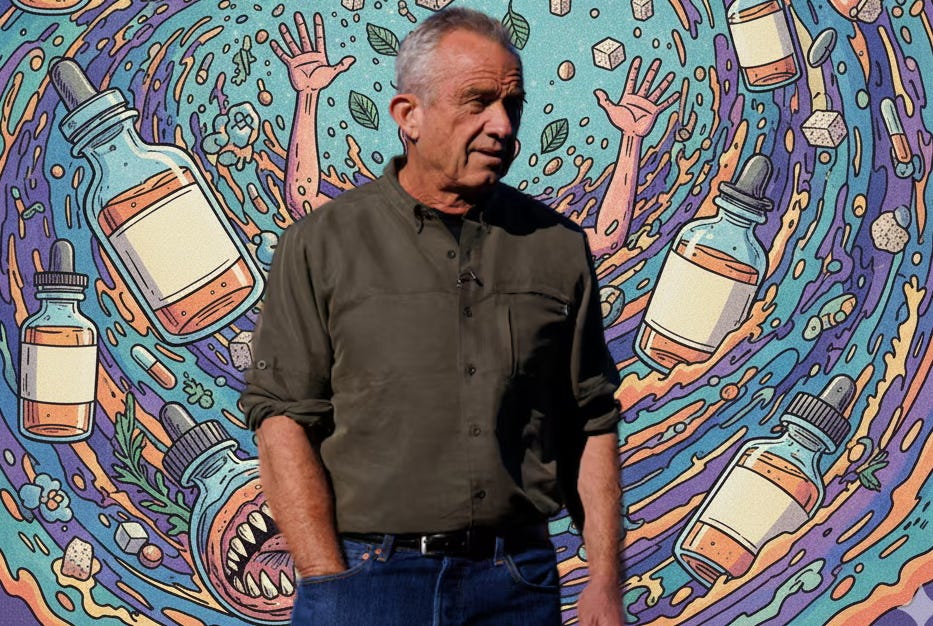
On January 22, West Virginia House Bill 4760 was introduced into the legislature. Here’s how it opens:
A BILL to amend the Code of West Virginia, 1931, as amended, by adding a new article, designated §33-59A-1, relating to health; and requiring insurance to cover costs for dietary supplements and nutrition prescriptions.
HR 7050, introduced in the House of Representatives last month, fits a similar mold. “The Homeopathic Drug Product Safety, Quality, and Transparency Act” would ensure that homeopathic products are exempt from any regulatory framework other drugs have to go through. If passed:
The FDA would be explicitly prohibited from requiring premarket approval for homeopathic products, which is the core mechanism by which the agency evaluates whether drugs are safe and effective before they reach consumers.
Homeopathic products would be explicitly shielded from the FTC false advertising enforcement; manufacturers could make health claims without any fear of retribution.
Private rights of action by consumers would be blocked, meaning you would not be able to sue homeopathic companies for making false claims.
The bill also calls for the creation of a 10-member Homeopathic Drug Product Advisory Committee, with 9 of 10 seats going to homeopathic practitioners, manufacturers, and consumer advocates.
In a nutshell, everything RFK Jr criticizes the pharmaceutical industry for, he’s replicating for his buddies in homeopathy. (For a deeper dive into my issues with homeopathy, check out this 2018 article.)
A year ago, when Kennedy was installed as Secretary of HHS, I made two predictions:
He was only being given the position if he were going to abide by Project 2025’s deregulatory agenda, and would vote for anything that deregulates alt-med products and services
His tenure would be marked by the privatization of healthcare with gifts to the alt-med and supplements industries
Over the last year, we’ve watched the first phase of the classic guru playbook: fear conditioning.
Across numerous states, and at the federal level, Kennedy and his MAHA team have attempted to make Americans frightened of fluoride, OTC painkillers, GLP-1 medication, food dyes, seed oils, carbohydrates, processed foods, and, of course, vaccines.
Now we’re entering phase two: sell solutions.
The West Virginia legislation is the first step in opening the doors wide open for supplements grifters while the federal bill would make homeopathic manufacturers exempt from any oversight.
Bill 4760 was introduced by West Virginia House Republicans Adam Burkhammer and Evan Worrell.
Burkhammer is a businessman and politician serving in the West Virginia House of Delegates from the 64th district, where he’s on the Health and Human Resources committee. He has adopted or fostered 10 kids with his wife. One of their foster children apparently struggled with hyperactivity; Burkhammer claims they removed synthetic dyes from the family’s diet and reported significant behavioral improvements.
He turned that experience into legislation, sponsoring a bill to ban seven food dyes in the state. That bill became law in March 2025, making West Virginia the first state to enact such a sweeping ban. Since then he’s become a prominent figure in the state-level MAHA movement.
If this supplements bill passes, a number of MAHA-friendly states will likely introduce similar bills.
Evan Worrell works as a healthcare data analytics consultant and also chairs the House Health and Human Resources Committee. He was a key legislative champion of the same food dye ban, and has criticized state governor Patrick Morrisey for “being worked over by the beverage association.” You might remember Morrissey from a joint press conference with Kennedy last year, in which the latter man said “The first time I saw him, I said, ‘You look like you ate Governor Morrisey’” in front of a televised audience. He then put Morrisey on a carnivore diet.
Together, these two delegates, along with other Republican members of the West Virginia state house, have introduced dozens of bills targeting vaccines, fluoridated water, and PFAS, aka “forever chemicals.” West Virginia was one of the first states to jump aboard the “don’t let SNAP recipients have soda” wave, a block that took effect on Jan 1.
While state politicians claim that they’re replacing soda with healthy, nutritious options, there’s been no talk about how they’re going to mandate supply chain infrastructure reforms to allow for that to happen. Morrisey said SNAP recipients will have access to “healthy bundles” of fresh produce, lean meat, and hot foods, though there’s no word on that actually happening yet. Roughly 300,000 West Virginians, or one in six residents, rely on SNAP benefits; one-quarter of residents live in areas classified as food deserts.
Which gets to the heart of the problem: most Americans, regardless of political affiliation, want a healthy population. As public health experts know, accomplishing that means addressing structural problems in society. In this case, it would mean first making sure those 300,000 West Virginians have access to “healthy bundles,” then taking soda off their list of options. (I’m not arguing whether that’s the right move or not, but from a structural perspective, you first address the solution, then tackle what you perceive to be a problem.)
That’s not how MAHA works. Kennedy and crew consider handshake deals with food companies that claim they’re removing food dyes and state legislation that bans products from state programs “wins.” An actual win would provide SNAP recipients with the healthy bundles they like to market, not tell them what they can’t have and forget about them.
Which is why MAHA is really just a marketing operation. It’s unlikely they have any actual concern with infrastructure. Kennedy has avoided all talk of the social determinants of health. When asked about socialized medicine, he towed the Republican line that “people want choice,” an absurd punt considering we could create a system where people both have access to health care no matter their income level and a choice in their primary doctor. The will just isn’t there in a deregulatory administration; it’s antithetical to their goal of privatizing as many aspects of healthcare as possible.
Back to Bill 4760. The graph that really jumps out:
“Nutritional wellness and prevention” means nutritional measures and products, including dietary supplements, whose primary purposes are to enhance health, improve nutritional intake, strengthen the immune system, cleanse the body of toxins, address specific health needs and aid in resisting disease, nutritional and dietary counseling, and nutrition prescriptions.
This sounds like it was written by a wellness influencer, not someone who takes science and medicine seriously.
First, the idea that supplements “strengthen the immune system.” According to the NIH Office of Dietary Supplements, only certain vitamins and minerals show very modest effects in specific populations, with a caveat:
Vitamin D: Clinical evidence shows supplementation reduced the risk of common cold and acute respiratory infections by 4% overall, with an 18% reduced risk among men but no significant effect among women. A British Medical Journal meta-analysis of 25 trials found vitamin D supplementation was protective against acute respiratory infections, with the greatest benefits in people with the lowest vitamin D levels.
Vitamin C: The effects are modest. Supplementation shortened cold symptom duration by 9% and was more effective in people with low vitamin C status, which makes sense given that it’s a supplement.
Zinc: Studies show zinc supplementation shortens diarrhea duration by about half a day in children over 6 months and was studied primarily in Asian countries with high zinc deficiency rates.
Now the caveat: Harvard Medical School has found there’s no evidence these supplements help in fighting disease. The very idea of boosting the immune system is flawed because the immune system is finely tuned. While some supplements and preparations alter immune function components, there’s no evidence they bolster immunity to the point where you’re better protected against infection and disease. That’s not big pharma refusing to test supplements; that comes from decades of clinical evidence.
That’s the immune side. How about “cleansing the body of toxins?”
The National Center for Complementary and Integrative Health (NCCIH) published a 2015 review that concluded there was no compelling research to support the use of detox diets for weight management or eliminating toxins from the body.
Johns Hopkins Medicine found that liver cleanses aren’t recommended because they lack clinical evidence and don’t reverse damage from overeating or alcohol. Some supplements even cause liver injury.
The University of Chicago’s hepatology department found there are very few, if any, well-designed scientific studies showing benefit to detox supplements. It’s ironic that wellness influencers big pharma is hiding this evidence because if there was clinical proof, drug companies would be making trillions of dollars on them at this point.
Your liver naturally eliminates toxins and waste through bile and urine. It doesn’t need anything “extra” to function well.
The irony is that there are ways that you can help your immune system and liver function properly. Eat a balanced diet. Exercise regularly. Stay hydrated. Get good sleep. Avoid excessive alcohol. All the basics we’ve heard about forever.
But that’s not sexy and doesn’t move products. Instead Kennedy calls supplements suppressed when they’re nearly completely unregulated. Now, through the MAHA coalition he’s built in state governments, he’s about to open the door for a whole lot of his friends to make a killing by forcing insurance companies to pay for them.
A few Kennedy confidantes with a vested interest in this legislation:
Calley Means, Kennedy’s senior adviser, co-owns Truemed, a platform that helps companies selling supplements, classes, and snacks become eligible for purchase with tax-free health savings account dollars. Because he’s classified as a special government employee, he’s exempt from divestment requirements.
Calley’s sister, Casey Means, who is up for surgeon general pick, has earned more than a quarter-million dollars from supplements companies via newsletters sponsorships, partnerships, or speaking fees.
Mark Hyman, whom Kennedy called his “friend and partner on these issues for 20 years,” runs Function Health, whose valuation skyrocketed from $191 million in June 2024 to $2.5 billion in February 2025, the month Kennedy took office. He also has many supplements for sale on his site.
Vani Hari (”The Food Babe”), who owns the supplement and health bar brand Truvani, appeared alongside Kennedy at an April press conference announcing his food dye ban, where he called her “an extraordinary leader.”
Gary Brecka owns 10X Health System that sells a $133k light bed and oxygen machine, with 10 different supplements on the downline from their $600 genetic test. Kennedy chums around with Brecka often and has stated that at-home test kits and devices like CGMs for non-diabetics should be more widely available, so I expect those will be coming down the pipe.
Paul Saladino, who did pullups with Kennedy at an airport and shared raw milk shots with him in the White House, owns Heart & Soil, an organ meat supplements company.
Will Cole, Josh Axe, and Rho Nutrition co-founder George Padilla are also closely aligned friends with Kennedy who sell supplements.
Mark McAfee, CEO of Raw Farm in California, has been in contact with Kennedy, who asked McAfee to apply to be an FDA adviser on raw milk policy. As stated with Saladino, Kennedy is a big raw milk fan, and remember, this WV house bill is also for “nutrition prescriptions,” so I expect raw milk will be covered as well.
Speaking of, Sally Fallon Morell, founding president of the Weston A. Price Foundation, connected Kennedy with raw milk distributors and has been pressuring him on raw milk policy.
Then there’s the Alliance for Natural Health, which published a pamphlet entitled The MAHA Mandate, which outlines how Kennedy can “free supplements companies to make broader health claims.” Right, because they’re not free right now.
Medical writer Arthur Allen covered Kennedy shortly after being confirmed at HHS:
In fact, the FDA can’t even require that supplements be effective before they are sold. When Congress, at the agency’s urging, last considered legislation to require makers of vitamins, herbal remedies, and other pills and potions to show proof of their safety and worth before marketing the products, it got more negative mail, phone calls, and telegrams than at any time since the Vietnam War, by some accounts. The backlash resulted in a 1994 law that enabled the dietary supplement industry to put its products on the market without testing and to tout unproven benefits, as long as the touting doesn’t include claims to treat or cure a disease. Annual industry revenues have grown from $4 billion to $70 billion since.
That law was DHSEA, introduced by two senators who benefited from supplements industry money. But that was 32 years ago and there’s more money—much more money—to be made from what are virtually unregulated pharmaceuticals. Yes, I know wellness influencers love to claim the “naturalness” of their products that are mostly synthesized in the same manner as prescription drugs. That’s part of their sleight of hand.
As the Wall St Journal recently noted:
Kennedy has said in podcast interviews that he takes “a ton” of vitamins and has trumpeted stories of people using vitamins to treat infectious disease. In his 2021 book, “The Real Anthony Fauci,” which critiques the government’s response to the Covid-19 pandemic, he writes about a Detroit-area holistic medicine doctor who treated Covid patients in their cars with vitamins A, C and D; iodine; and hydrogen peroxide.
Last week, Kennedy publicly stated that the keto diet can cure schizophrenia and bipolar disorder. He cited Dr Pollan at Harvard, by which he likely meant Dr Chris Palmer. After extolling completely unproven benefits of a keto diet—a high fat diet—Kennedy said Americans need to “eat protein.”
Keto is a low-protein diet.
Why start making anything coherent at this point? Kennedy failed his way to the top of the nation’s public health infrastructure, where he spreads misinformation on a daily basis.
Besides, the crowd at that event started clapping when he said “eat protein.” Who needs science when you got vibes—and tons of state legislators willing to do your bidding so your buddies in the private market can make a killing?